

Related content
- Sep 09, 2026Winnex Air Direct Expansion (DX) Air Handling UnitThe Winnex Air Direct Expansion (DX) Air Handling Unit is a highly versatile and adaptive integrated temperature and air handling solution. Unlike dedicated computer room air conditioners, it is no longer limited to data center scenarios and serves a wide range of industrial, commercial, scientific and special environmental cooling needs.
- Sep 05, 2026Winnex Air In-Row Precision Air Conditioner | Optimized Cooling for High-Density Data CentersEquipped with a full Chinese high-definition large-screen graphical interactive interface and multi-level password protection to prevent illegal operation and ensure equipment safety. The system visually displays the operating status and cumulative running time of all core components in real time, allowing operators to grasp unit conditions at a glance. The built-in expert intelligent fault diagnosis system automatically identifies and accurately displays fault information, greatly reducing maintenance difficulty.
- Jul 05, 2026Full Introduction to Chilled Water In-Row Air Conditioner | Central Water Close-Coupled Cooling Equipment for Large High-Density Data CentersExplore chilled water in-row air conditioners for large data centers, delivering high-density cooling, low noise and energy-efficient operation.
- Jun 29, 2026Six Core Advantages of DX Air-Cooled In-Row Air Conditioner | Analysis of Waterless Direct Expansion Cooling Equipment for Server RoomsExplore 6 advantages of DX in-row air conditioners for server rooms: waterless cooling, modular expansion, energy savings and smart PLC control.
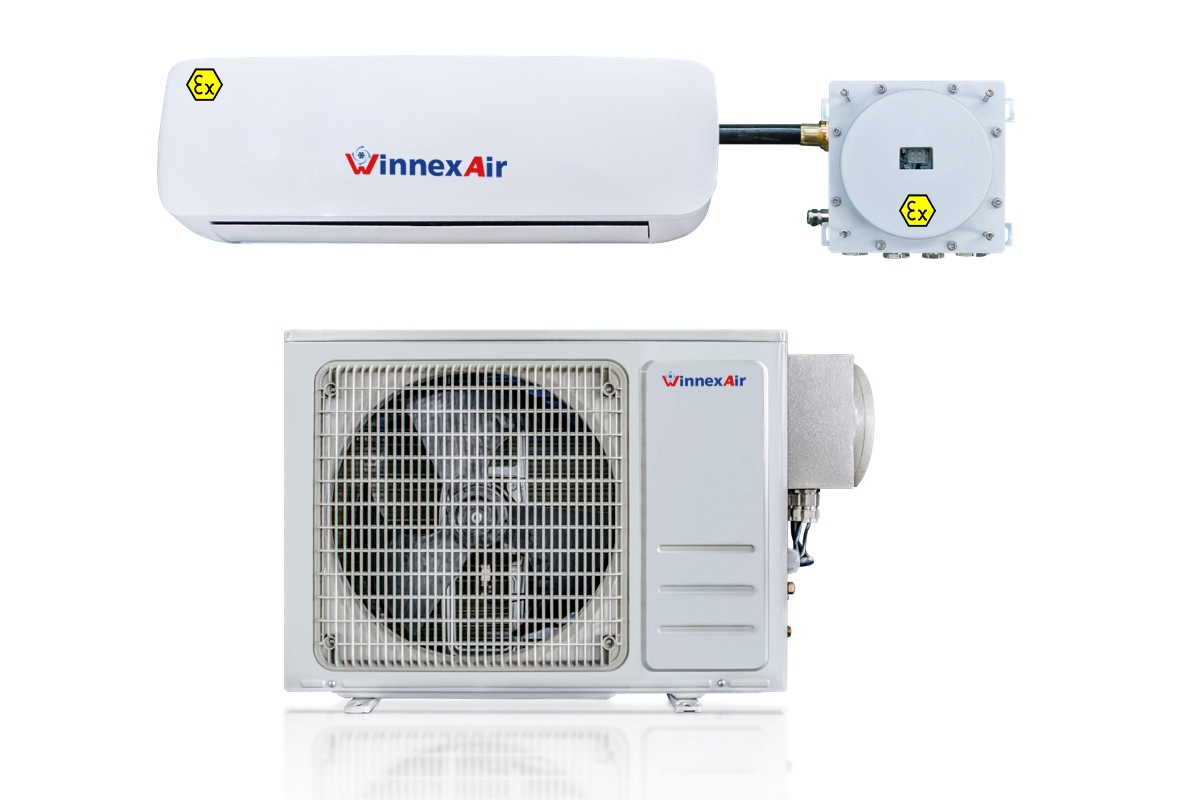
I. Electrical System Explosion-Proof: The "Core Line of Defense" to Eliminate Ignition Sources
The electrical system is a key risk area of explosion-proof air conditioners. WINNEX AIR completely eliminates the hidden danger of electrical sparks from components to lines through full-link technical control:
Explosion-Proof Electrical Components: Core components such as compressors, fan motors, thermostats, and relays are all explosion-proof dedicated models — explosion-proof motors adopt flameproof enclosures (Ex d) with a protection level of ≥IP54, which can effectively block the leakage of internal electrical sparks; thermostats and relays are of intrinsic safety type (Ex ia), with circuit energy ≤0.2mJ, and will not generate ignition energy even in case of failure.
Full-Link Explosion-Proof Lines: Electrical lines all use flame-retardant explosion-proof cables, with insulation layers made of cross-linked polyethylene material and a temperature resistance range of -40℃~125℃; explosion-proof junction boxes are used for sealing at cable connections, and the box body is made of cast aluminum alloy, with explosion-proof sealant filled at the joints to prevent the exposure of electrical sparks caused by line short circuits or open circuits.
Intrinsically Safe Circuit Design: The circuit design strictly follows the "energy limitation" principle, and precisely controls current (≤100mA) and voltage (≤36V) through current-limiting resistors and voltage-stabilizing modules, ensuring that the energy released by the circuit is lower than the minimum ignition energy of flammable gases (e.g., the minimum ignition energy of methane is 0.28mJ) under normal operation and fault conditions.
II. Shell Explosion-Proof Design: The "Physical Barrier" to Block Risk Propagation
The shell is the "first safety wall" of explosion-proof air conditioners. WINNEX AIR meets explosion-proof requirements in all aspects from materials, processes to identification:
High-Strength Explosion-Resistant Materials: The shell is made of high-quality steel plates or 304 stainless steel through integral molding, with a thickness of ≥5mm, a tensile strength of ≥210MPa, and impact resistance meeting the IEC 60079 standard. Even if an explosion occurs inside, it can withstand the explosion pressure without breaking, avoiding the spread of danger.
Precision Sealing Process: The joint surface of the shell is processed by CNC precision machining, with a surface roughness of ≤3.2μm and a sealing gap of ≤0.1mm. It is matched with nitrile rubber sealing rings that are oil-resistant and corrosion-resistant to achieve "complete isolation between internal and external environments", preventing external flammable and explosive gases and dust from entering the internal electrical cavity.
Clear Explosion-Proof Rating Marking: The prominent position of the shell is marked with explosion-proof marks (e.g., Ex d IIB T4 Gb, Ex e IIC T6 Ga) to clearly indicate the applicable scenarios — Ex d (flameproof type) is suitable for high-risk environments in Zone 1 and Zone 2, Ex e (increased safety type) is suitable for general hazardous environments in Zone 2, and Ex p (pressurized type) can be used in special closed scenarios, allowing customers to intuitively understand the equipment's adaptation range.
III. Refrigeration System Explosion-Proof: The "Key Link" to Ensure Temperature Control Safety
The stability of the refrigeration system directly affects the overall safety of the equipment. WINNEX AIR fully controls from refrigerants to components:
Safe Refrigerants: Refrigerants that are non-flammable and chemically stable (e.g., R410A, R32 explosion-proof models) are selected, with a flammability limit range of ≤10% (volume fraction). Even if leaked, they will not cause explosions, and at the same time meet environmental protection requirements (ODP value is 0).
Fully Sealed Refrigeration Pipes: The refrigeration pipes are made of seamless copper pipes, and the connection parts are sealed by brazing process, with a leakage rate of ≤1×10⁻⁹ Pa·m³/s; the fins of condensers and evaporators undergo high-pressure leak detection tests (pressure ≥2.5MPa) to eliminate refrigeration failure and safety hazards caused by leakage.
IV. Additional Protection Technologies: "Value-Added Guarantee" for Multi-Dimensional Safety Enhancement
In addition to core technologies, WINNEX AIR is additionally equipped with multiple protection technologies to further improve the equipment's safety level:
Flameproof Cavity Design: The interior of the equipment is divided into independent flameproof cavities such as electrical cavity, refrigeration cavity, and control cavity. Flameproof gaps (≤0.2mm) are set between the cavities. Even if an extreme situation occurs in one cavity, it can block the spread of flame to other cavities or the external environment.
Anti-Static and Grounding Protection: The surface of the shell is treated with electrostatic spraying, with a surface resistance of ≤1×10⁸Ω, which effectively prevents static accumulation; at the same time, an independent grounding system is provided, with a grounding resistance of ≤4Ω, and the grounding cable is a multi-strand copper core wire of ≥2.5mm², which quickly discharges static electricity and avoids risks caused by static discharge.
Positive Pressure Ventilation Technology: High-end models adopt positive pressure ventilation design, and continuously inject clean nitrogen (purity ≥99.99%) into the equipment through a dedicated fan to maintain an internal pressure of ≥50Pa, preventing external flammable gases from entering, and suitable for extremely high-risk scenarios such as hydrogen and acetylene.
Intelligent Monitoring and Protection System: Equipped with four sensors for temperature, pressure, humidity, and combustible gas, it collects equipment operation data in real time (temperature error ±0.5℃, pressure accuracy ±0.01MPa); once overheating (motor temperature ≥135℃), overpressure (refrigeration pressure ≥3.0MPa) or gas leakage (concentration ≥10% LEL) is detected, the system immediately starts shutdown, sound and light alarm, and sends text messages to maintenance personnel's mobile phones, realizing "early warning for abnormalities and early disposal of risks".


