Related content
- Oct 28, 2026Winnex Air Rooftop Explosion-Proof Air Conditioner | ATEX Certified Outdoor Rooftop Unit for Zone 1/2 Hazardous AreasThe Winnex Air rooftop explosion-proof air conditioner is designed and manufactured in strict accordance with ATEX Directive 2014/34/EU and the EN 60079 series, and holds an explosion-proof certificate issued by an authorized explosion-proof electrical product inspection body. Explosion-proof marking: Ex db ib mb IIC T4 Gb. The unit serves explosive hazardous locations in the petroleum, chemical, electric power, military and pharmaceutical industries, suitable for Zone 1 and Zone 2 areas where explosive atmospheres formed by Group ⅡA, ⅡB, ⅡC flammable gases or vapours and temperature classes T1–T4 mixed with air may exist. Engineered specifically for outdoor rooftop duty, the unit requires no dedicated machine room and occupies no indoor floor area, making it a rooftop explosion-proof air conditioning solution for centralized air treatment in hazardous-area plants, process units and supporting workshops.
- Oct 27, 2026Winnex Air BKT-200 Explosion-Proof Packaged Air Conditioner | High-Capacity Thermal Solution for Marine & Offshore ApplicationsIn marine vessels, offshore oil and gas platforms, FPSOs and offshore modules, HVAC equipment must withstand harsh marine conditions — salt spray, high humidity, persistent vibration and vessel motion — while complying with explosion-proof safety requirements for hazardous gas areas. The Winnex Air BKT-200 Explosion-Proof Packaged Air Conditioner is a high-capacity, all-in-one thermal unit engineered specifically for these marine and offshore high-risk scenarios. Its packaged design integrates cooling, heating, humidification, steam heating and explosion-proof electrical control into a single unit. Fully tested and explosion-proof certified before delivery, it significantly reduces on-site installation work — ideal for space-constrained marine vessels and offshore platforms.
- Oct 26, 2026Winnex Air Explosion-Proof Air Conditioning System | 50°C High-Temperature Explosion-Proof SolutionThe Winnex Air explosion-proof air conditioning system is engineered for explosive hazardous areas in the petroleum, chemical, electric power, military, pharmaceutical and marine engineering industries, with thermal design and explosion protection specifically addressing 50°C high-temperature environments. The system is designed and manufactured in accordance with ATEX Directive 2014/34/EU and the EN 60079 series. Explosion-proof marking: Ex db mb IIC T4 Gb, suitable for Zone 1 and Zone 2 explosive hazardous areas. Complete explosion-proof technical documentation is available to support HSE review and site acceptance for overseas projects. For industrial projects requiring stable cooling in continuous high temperature, corrosive atmospheres and hazardous areas, Winnex Air provides integrated support from explosion-proof air conditioner selection and technical specification confirmation to maintenance planning.
- Oct 25, 2026Winnex Air Ducted Explosion-Proof Air Conditioner | Concealed Explosion-Proof Ducted Unit for Concealed Air Supply in Hazardous AreasExplore the Winnex Air ducted explosion-proof air conditioner for Zone 1 and Zone 2 hazardous areas. ATEX-compliant design combines concealed ceiling installation, multi-outlet airflow and low-noise operation. Contact our technical team for selection support.
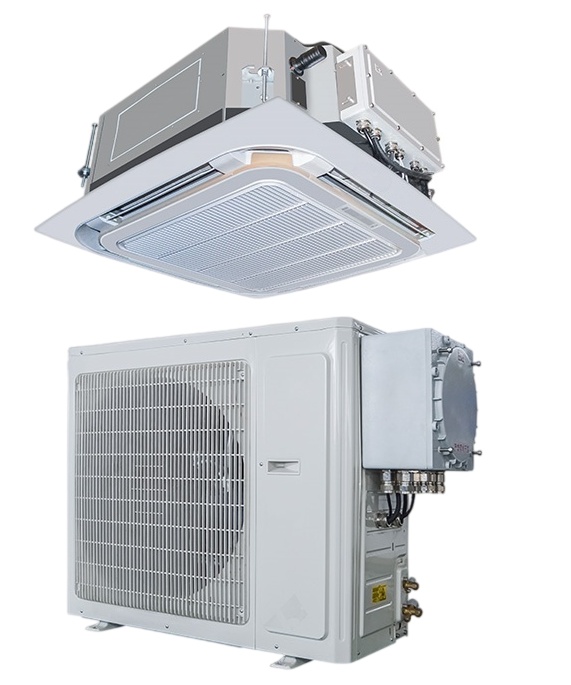
The Winnex Air explosion-proof air conditioning system is engineered for explosive hazardous areas in the petroleum, chemical, electric power, military, pharmaceutical and marine engineering industries, with thermal design and explosion protection specifically addressing 50°C high-temperature environments. The system is designed and manufactured in accordance with ATEX Directive 2014/34/EU and the EN 60079 series. Explosion-proof marking: Ex db mb IIC T4 Gb, suitable for Zone 1 and Zone 2 explosive hazardous areas. Complete explosion-proof technical documentation is available to support HSE review and site acceptance for overseas projects. For industrial projects requiring stable cooling in continuous high temperature, corrosive atmospheres and hazardous areas, Winnex Air provides integrated support from explosion-proof air conditioner selection and technical specification confirmation to maintenance planning.
Explosion-Proof Air Conditioning Designed for 50°C Conditions
Designing refrigeration equipment for 50°C ambient conditions makes the explosion-proof challenge more complex. As the temperature difference between the condenser and surrounding air narrows, heat rejection becomes increasingly difficult. A unit rated for 35°C ambient may lose 30% or more of its cooling capacity at 50°C — provided it can continue running at all. Material selection determines whether components survive sustained thermal and pressure loads: seals that remain elastic at moderate temperatures harden and crack at 50°C, compromising both explosion protection and refrigerant sealing; lubricating oil thins at high temperature and accelerates bearing wear; electronic control boards age faster as junction temperatures rise.
Winnex Air addresses these constraints through multiple engineering measures: increased heat exchanger surface area to compensate for the reduced temperature difference; refrigerant selection shifted toward working fluids that maintain favorable thermodynamic characteristics at higher condensing temperatures; and component derating to ensure electrical and mechanical parts operate well within their thermal limits even at the design ambient upper limit. In oil and gas projects, explosion-proof electrical systems must operate reliably under continuous high temperature and corrosive compounds present in oil and gas operations. Material specifications emphasize both corrosion resistance and thermal stability, helping the system remain functional throughout commissioning and early operation and reducing safety risks commonly associated with equipment selection that does not match environmental requirements.
How Explosion-Proof AC Maintains Efficiency in Extreme Heat
Maintaining cooling efficiency at 50°C requires careful engineering choices rather than simply oversizing equipment. Enhanced heat exchangers with optimized fin geometry and tube row arrangement maximize heat transfer per unit surface area; high-efficiency compressors designed for elevated condensing pressure reduce the energy penalty of high-temperature operation. Internal thermal management prevents cascading failures when control electronics overheat — sensitive components are placed in thermally isolated compartments or receive dedicated cooling airflow, and temperature sensors inside the unit feed data back to the control system, which can adjust operation during thermal excursions to prevent damage.
The practical result is equipment that continues to deliver rated capacity rather than degrading with operating conditions. Energy consumption remains predictable, and maintenance intervals remain stable rather than being compressed by premature component aging. For facilities operating in remote or difficult-to-access locations, this reliability translates directly into lower operating costs and fewer interventions in hazardous areas — every maintenance activity carries inherent risk.
ATEX Certification and International Standard Compliance
International certification frameworks set the baseline for explosion-proof equipment. The ATEX Directive regulates equipment sold in the European Union and defines essential health and safety requirements through detailed technical standards; the EN 60079 series provides harmonized technical requirements for electrical equipment in explosive atmospheres. The Winnex Air explosion-proof air conditioning system is designed and manufactured in accordance with ATEX Directive 2014/34/EU and the EN 60079 series. Explosion-proof marking: Ex db mb IIC T4 Gb, suitable for Zone 1 and Zone 2 explosive hazardous areas. Within these frameworks, several classification parameters determine suitability for a specific application:
Temperature class requires particular attention in high-temperature applications. A unit operating at 50°C ambient will have higher surface temperatures than the same unit at 25°C, and the temperature class must account for this increase to ensure surface temperatures remain below the ignition threshold of any hazardous substance that may contact the equipment. T4 temperature class has a maximum surface temperature of 135°C, providing an 85°C margin at 50°C ambient — notably smaller than the 110°C margin available at 25°C. Equipment design must account for this reduced margin through enhanced heat dissipation or a more conservative temperature class. The Winnex Air explosion-proof air conditioning system is designed and documented in accordance with ATEX and EN 60079 series requirements, reflecting both the global nature of industrial projects and the differentiated regulatory requirements of different jurisdictions.
Standards for Explosion-Proof Air Conditioning in High-Temperature Environments
High-temperature operation introduces specific requirements within the ATEX and EN 60079 series frameworks. Material compatibility clauses address the possible degradation of polymers, elastomers and lubricating oils under sustained thermal stress; components that meet explosion protection requirements at moderate temperatures may no longer do so after thermal aging impairs their mechanical properties. Ingress protection and temperature considerations are interlinked — thermal cycling stresses seals and gaskets and may open pathways for dust or moisture ingress, and the IP rating must be maintained throughout the equipment service life, not only at initial installation.
Therefore, selection of high-temperature explosion-proof air conditioning should not be limited to checking the explosion-proof marking. It should also confirm temperature class margin, material temperature ratings, long-term IP protection and thermal management of control electronics. For overseas projects requiring ATEX certified explosion-proof air conditioners, technical specifications should clearly state zone classification, gas group, temperature class, ambient upper limit and corrosive atmosphere conditions so that the supplier can provide targeted design.
Explosion-Proof Air Conditioning for High-Risk Industries
Industries requiring explosion-proof temperature control share a common characteristic: flammable or explosive atmospheres exist during normal operations, not only under abnormal conditions. Oil and gas facilities handle hydrocarbons throughout extraction, processing and storage; chemical plants handle solvents, reactants and intermediates within explosive limits; pharmaceutical manufacturing uses flammable solvents in synthesis and coating operations; mining operations generate combustible dust; marine applications combine confined spaces with fuel vapor and cargo atmospheres. Each application imposes specific requirements beyond basic explosion protection — oil and gas operations require corrosion resistance suitable for sulphides and mechanical robustness for construction-phase handling and long-term vibration; new pharmaceutical plants must meet cleanliness expectations while adapting to specific electrical distribution architectures.
Winnex Air provides customized explosion-proof temperature control solutions for these high-risk industries, covering oil and gas explosion-proof air conditioning, Zone 1/2 explosion-proof air conditioning, high-temperature explosion-proof air conditioning and corrosion-resistant explosion-proof air conditioning applications.
Explosion-Proof Air Conditioner Selection Guide for High-Temperature Plants
Equipment selection begins with site characterization: zone classification determines the required equipment protection level, substances present determine the required temperature class, ambient conditions set thermal design parameters, and corrosive atmospheres — whether from process chemicals or marine salt spray — determine material specifications. Cooling load calculations must account for all heat sources in the conditioned space: process equipment, lighting, personnel, solar heat gain through walls and roofs, and infiltration of hot outside air. Oversizing provides an uncertainty margin but increases capital cost and may impair humidity control; undersizing results in insufficient cooling under peak conditions, potentially forcing process turndown or creating unsafe working conditions.
Maintenance accessibility should be considered during selection. Equipment installed in hazardous areas may require hot work permits, gas testing and other precautions for routine maintenance; units designed for external maintenance access — with filters, controls and refrigerant connections accessible from outside the hazardous zone — can reduce the frequency and duration of work within classified areas. Integration with existing control systems affects both installation complexity and operational effectiveness: units that communicate with plant-level monitoring systems enable centralized supervision and early issue detection, while standalone units are simpler to install but require separate monitoring arrangements.
As an explosion-proof air conditioner supplier serving global industrial projects, Winnex Air provides technical specification confirmation, selection support, technical consultation and quotation services for explosion-proof air conditioning, helping project teams balance explosion-proof compliance, high-temperature cooling capacity and lifecycle cost.
Lifecycle Value and Long-Term Performance
The purchase price of an explosion-proof air conditioner represents only a small portion of total cost of ownership. Energy consumption over a 15–20 year service life typically significantly exceeds initial capital cost, and maintenance requirements — including routine maintenance and unplanned repairs — further increase lifecycle cost. Downtime during equipment failure can interrupt production, with costs far exceeding the value of the equipment itself. Quality equipment designed for actual operating conditions minimizes these lifecycle costs: components operating within their design limits last longer and fail less often, high-efficiency heat exchangers and compressors reduce energy consumption throughout the service life, and robust construction withstands the handling and environmental stresses unavoidable in industrial environments.
Winnex Air’s commitment to lifecycle management extends beyond equipment supply. Preventive maintenance plans identify issues before they cause failures, and technical support helps operators optimize equipment performance for their specific conditions. This ongoing cooperation builds operational knowledge that keeps equipment reliable year after year.
Contact Winnex Air for Explosion-Proof AC Solutions
For explosion-proof air conditioning designed for 50°C ambient conditions and compliant with ATEX and EN 60079 series requirements, or for Zone 1/2 high-temperature explosion-proof air conditioner selection support and quotation, please contact Winnex Air. Our engineering team provides technical consultation, equipment selection support and customized design for hazardous-area temperature control applications.
Web: www.WinnexAir.com Email: info@WinnexAir.com
Explosion-Proof Air Conditioning FAQ
Q1: What design features make an air conditioner suitable for explosion-proof service at 50°C?
Explosion-proof air conditioning combines two distinct engineering requirements. Explosion protection comes from enclosure design — flame paths, material thickness and construction methods that contain any internal ignition and prevent flame propagation to the surrounding atmosphere. High-temperature capability comes from thermal engineering — enhanced heat exchangers, appropriate refrigerant selection and component derating that maintain cooling capacity and equipment life at 50°C ambient. Both requirements must be met simultaneously; equipment that satisfies only one is not suitable for the application.
Q2: How does 50°C ambient temperature affect explosion-proof air conditioner performance over time?
Sustained high-temperature operation accelerates several aging mechanisms: elastomeric seals and gaskets lose elasticity, potentially compromising both refrigerant sealing and explosion protection; lubricating oil degrades faster, increasing bearing and compressor wear; elevated junction temperatures accelerate electronic component aging. Equipment designed for high-temperature service addresses these mechanisms through material selection and component derating; units designed for moderate temperatures but operated at 50°C will experience shortened service life and higher failure rates regardless of their explosion-proof rating.
Q3: Which maintenance practices extend equipment life in high-temperature hazardous environments?
Preventive maintenance in such environments focuses on components most affected by heat and hazardous atmosphere exposure: filter inspection and replacement prevent airflow restriction that raises operating temperatures; refrigerant charge verification ensures the system operates at design conditions; electrical connection inspection identifies corrosion or loosening that could create ignition sources; seal and gasket inspection catches degradation before it compromises explosion protection or causes refrigerant loss. Scheduling maintenance during cooler periods where possible reduces thermal and pressure stress on both equipment and maintenance personnel. To discuss a maintenance plan for your specific installation, contact info@WinnexAir.com.