

Related content
- Sep 09, 2026Winnex Air Direct Expansion (DX) Air Handling UnitThe Winnex Air Direct Expansion (DX) Air Handling Unit is a highly versatile and adaptive integrated temperature and air handling solution. Unlike dedicated computer room air conditioners, it is no longer limited to data center scenarios and serves a wide range of industrial, commercial, scientific and special environmental cooling needs.
- Sep 05, 2026Winnex Air In-Row Precision Air Conditioner | Optimized Cooling for High-Density Data CentersEquipped with a full Chinese high-definition large-screen graphical interactive interface and multi-level password protection to prevent illegal operation and ensure equipment safety. The system visually displays the operating status and cumulative running time of all core components in real time, allowing operators to grasp unit conditions at a glance. The built-in expert intelligent fault diagnosis system automatically identifies and accurately displays fault information, greatly reducing maintenance difficulty.
- Jul 05, 2026Full Introduction to Chilled Water In-Row Air Conditioner | Central Water Close-Coupled Cooling Equipment for Large High-Density Data CentersExplore chilled water in-row air conditioners for large data centers, delivering high-density cooling, low noise and energy-efficient operation.
- Jun 29, 2026Six Core Advantages of DX Air-Cooled In-Row Air Conditioner | Analysis of Waterless Direct Expansion Cooling Equipment for Server RoomsExplore 6 advantages of DX in-row air conditioners for server rooms: waterless cooling, modular expansion, energy savings and smart PLC control.
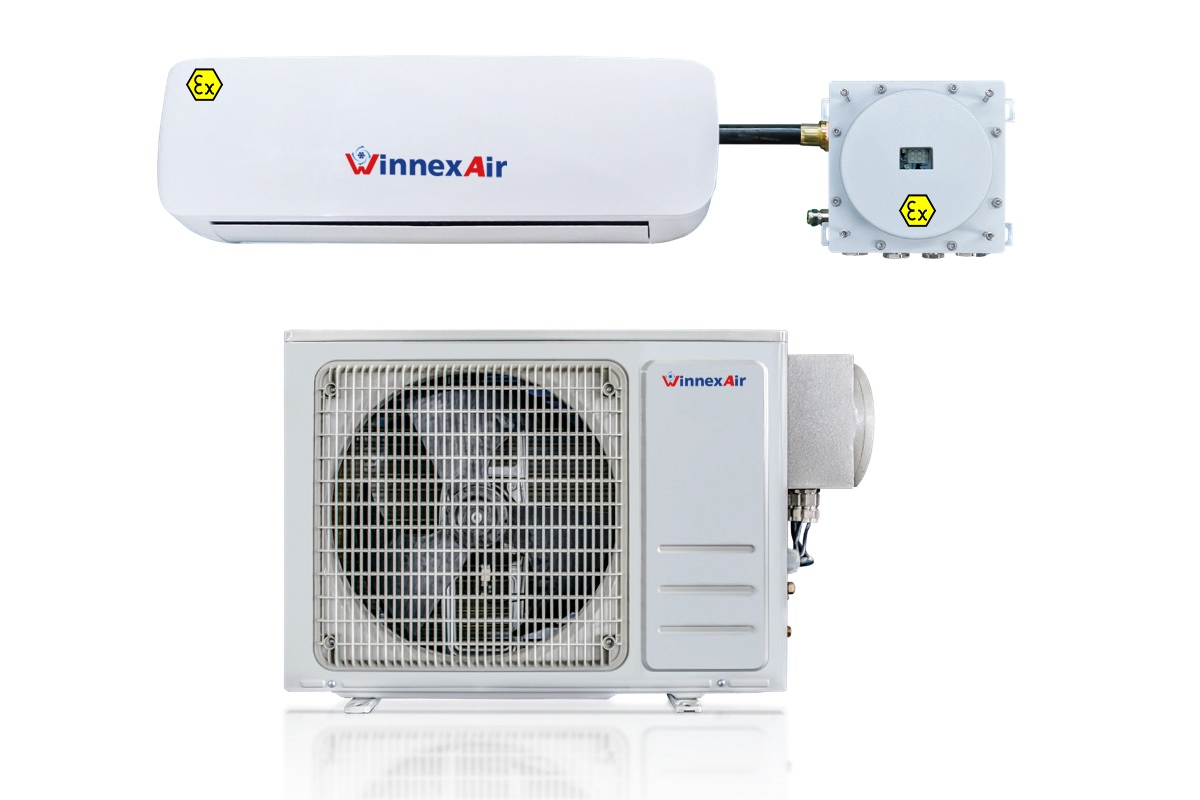
1. Design Goal: Safety First vs. Comfort First
• Explosion-Proof Air Conditioners: Centered on "eliminating ignition sources", all components are designed for "explosion prevention" — motors and compressors are enclosed in flameproof housings, terminal blocks are equipped with explosion-proof sealing sleeves, and moving parts undergo anti-static treatment. Even if an internal fault occurs, it can block the leakage of sparks, fundamentally preventing the ignition of flammable and explosive substances (such as gas, dust) in the environment.
• Regular Air Conditioners: Aimed at "temperature control comfort", they only meet the needs of cooling/heating in conventional environments, with no explosion-proof design. Electrical components are exposed, and mechanical friction has no anti-static treatment. If used in high-risk environments, even tiny circuit sparks may trigger safety accidents.
2. Application Scenarios: High-Risk Environments vs. Conventional Scenarios
• Explosion-Proof Air Conditioners: Exclusive to places with explosion risks such as petrochemical workshops, coal mine dust areas, high-risk pharmaceutical raw material rooms, and military ammunition warehouses. They are "essential products" for ensuring production safety, suitable for explosive gas environments (Zones 0-2) and combustible dust environments (Zones 20-22).
• Regular Air Conditioners: Suitable for scenarios without explosion hazards such as homes, offices, and general industrial workshops. They only serve the function of "adjusting temperature and humidity to improve comfort" and cannot be used in high-risk environments.
3. Implementation Standards: Explosion-Proof Certification vs. Basic Safety Certification
• Explosion-Proof Air Conditioners: Must comply with national explosion-proof standards (e.g., GB 3836 series) and international certifications (e.g., ATEX/UL). Each unit is marked with an exclusive explosion-proof label (e.g., Ex d IIB T4 Ga), and the entire process from R&D to production is subject to strict safety supervision to ensure 100% compliance with the requirements of high-risk environments.
• Regular Air Conditioners: Only need to pass basic civil/industrial safety certifications (e.g., 3C certification) with no explosion-proof standard constraints. The core evaluation indicators are conventional performance such as energy efficiency and noise, without any explosion-proof capability.
4. Usage Cost: Safety Investment vs. Basic Investment
• Explosion-Proof Air Conditioners: Due to the use of flameproof materials and explosion-proof components, the initial purchase cost is 3-10 times that of regular air conditioners of the same specification. However, they can avoid tens of millions of yuan in losses caused by explosions in high-risk production. Maintenance requires professional explosion-proof teams to ensure that component replacements meet explosion-proof standards, safeguarding long-term safety value.
• Regular Air Conditioners: Low purchase cost and convenient maintenance, suitable for scenarios without safety risks. But if mistakenly used in high-risk environments, not only will the equipment be easily damaged, but it may also trigger irreversible safety accidents, with costs far exceeding the value of the equipment itself.


