

Related content
- Sep 09, 2026Winnex Air Direct Expansion (DX) Air Handling UnitThe Winnex Air Direct Expansion (DX) Air Handling Unit is a highly versatile and adaptive integrated temperature and air handling solution. Unlike dedicated computer room air conditioners, it is no longer limited to data center scenarios and serves a wide range of industrial, commercial, scientific and special environmental cooling needs.
- Sep 05, 2026Winnex Air In-Row Precision Air Conditioner | Optimized Cooling for High-Density Data CentersEquipped with a full Chinese high-definition large-screen graphical interactive interface and multi-level password protection to prevent illegal operation and ensure equipment safety. The system visually displays the operating status and cumulative running time of all core components in real time, allowing operators to grasp unit conditions at a glance. The built-in expert intelligent fault diagnosis system automatically identifies and accurately displays fault information, greatly reducing maintenance difficulty.
- Jul 05, 2026Full Introduction to Chilled Water In-Row Air Conditioner | Central Water Close-Coupled Cooling Equipment for Large High-Density Data CentersExplore chilled water in-row air conditioners for large data centers, delivering high-density cooling, low noise and energy-efficient operation.
- Jun 29, 2026Six Core Advantages of DX Air-Cooled In-Row Air Conditioner | Analysis of Waterless Direct Expansion Cooling Equipment for Server RoomsExplore 6 advantages of DX in-row air conditioners for server rooms: waterless cooling, modular expansion, energy savings and smart PLC control.
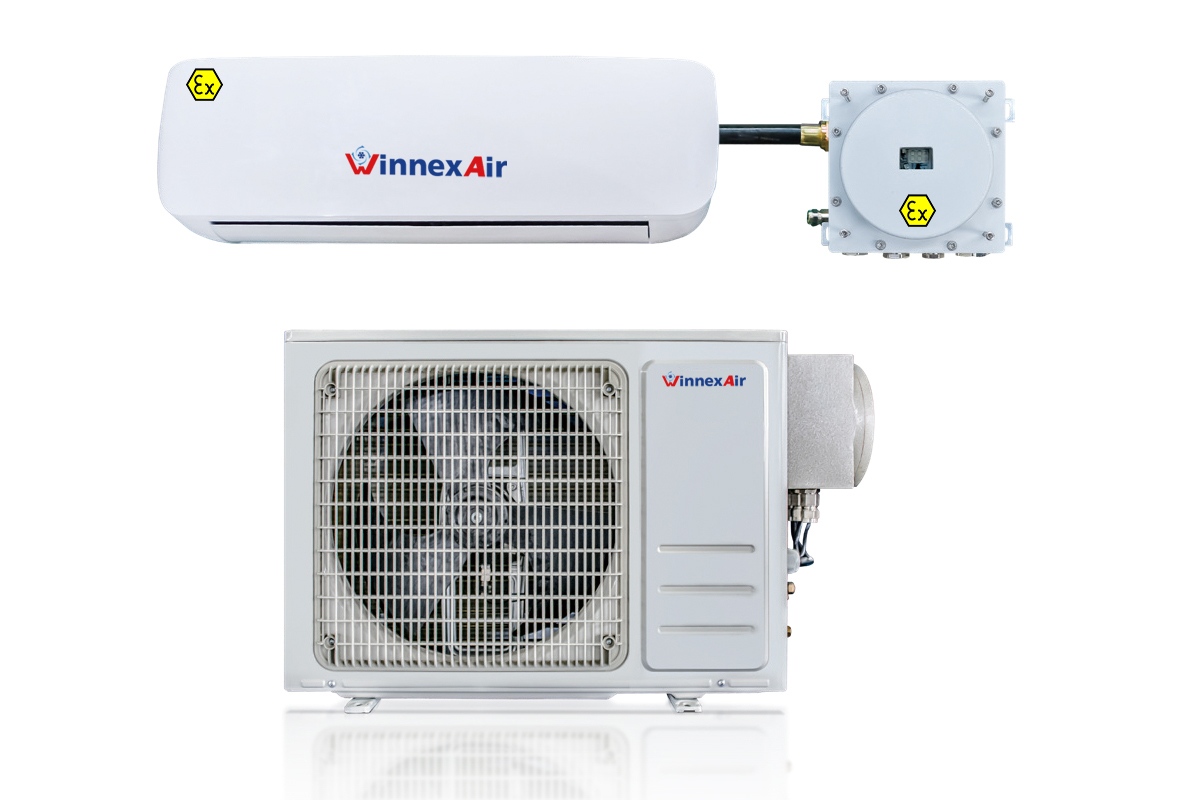
Explosion-proof air conditioners require systematic explosion-proof treatment for core functional components to eliminate ignition sources such as electric sparks, high temperatures, and mechanical friction from the source, ensuring safe operation in hazardous environments.
The key components involved are as follows:
1. Compressor: As the core power unit of the air conditioner, its motor must adopt an explosion-proof design. The terminal box uses an explosion-proof sealed structure to prevent the intrusion of flammable gases; the windings are made of explosion-proof grade insulating materials that are high-temperature resistant and anti-aging to avoid sparks caused by short circuits; the shell must have sufficient compressive strength to block the spread of flames even if abnormalities occur inside.
2. Control System: Components such as temperature controllers and pressure switches must be explosion-proof products. The internal circuit design complies with explosion-proof standards to prevent faulty electric sparks; the shell adopts a sealed flameproof structure with no high-temperature parts on the surface. Meanwhile, the probes and connecting wires of sensors (such as temperature and pressure sensors) need to be treated with explosion-proof sealed joints to prevent risks in the signal transmission process.
3. Fan: The fan motor must be an explosion-proof motor, with the same requirements for terminal box sealing and winding insulation as the compressor motor; the fan blades are made of materials that are not easy to generate sparks (such as special alloys or flame-retardant plastics), and maintain a reasonable gap with the shell to avoid ignition sources caused by friction during high-speed rotation.
4. Shell and Connecting Components: The overall shell of the unit adopts an explosion-proof structure design, with strength capable of withstanding possible internal explosion pressure; the connecting parts of the shell (such as door panels and side panel joints) need to be treated with explosion-proof sealing to prevent external flammable gases from entering; the surface is coated with anti-static and anti-spark coatings to avoid static discharge or sparks caused by mechanical collision.
5. Heat Exchanger and Pipes: The fins of the heat exchanger and refrigerant pipes are made of corrosion-resistant and high-strength materials to ensure sealing performance and prevent refrigerant leakage from mixing with flammable gases; at the same time, the heat dissipation design is optimized to prevent the surface temperature of the heat exchanger from becoming too high to reach the ignition temperature of explosive gases.


