

Related content
- Sep 09, 2026Winnex Air Direct Expansion (DX) Air Handling UnitThe Winnex Air Direct Expansion (DX) Air Handling Unit is a highly versatile and adaptive integrated temperature and air handling solution. Unlike dedicated computer room air conditioners, it is no longer limited to data center scenarios and serves a wide range of industrial, commercial, scientific and special environmental cooling needs.
- Sep 05, 2026Winnex Air In-Row Precision Air Conditioner | Optimized Cooling for High-Density Data CentersEquipped with a full Chinese high-definition large-screen graphical interactive interface and multi-level password protection to prevent illegal operation and ensure equipment safety. The system visually displays the operating status and cumulative running time of all core components in real time, allowing operators to grasp unit conditions at a glance. The built-in expert intelligent fault diagnosis system automatically identifies and accurately displays fault information, greatly reducing maintenance difficulty.
- Jul 05, 2026Full Introduction to Chilled Water In-Row Air Conditioner | Central Water Close-Coupled Cooling Equipment for Large High-Density Data CentersExplore chilled water in-row air conditioners for large data centers, delivering high-density cooling, low noise and energy-efficient operation.
- Jun 29, 2026Six Core Advantages of DX Air-Cooled In-Row Air Conditioner | Analysis of Waterless Direct Expansion Cooling Equipment for Server RoomsExplore 6 advantages of DX in-row air conditioners for server rooms: waterless cooling, modular expansion, energy savings and smart PLC control.
On large ocean-going cargo ships, container vessels, research vessels and offshore platforms, ventilation space on decks is limited. Traditional air-cooled air conditioners suffer severe cooling capacity loss under high temperature and high humidity marine conditions. Besides, integral water-cooled units are oversized, bringing great difficulties for cabin delivery and vessel retrofitting.
Winnex Air develops the Water-Cooled Split Marine Air Conditioner, which utilizes the vessel’s native seawater pipeline for heat exchange without performance loss caused by ambient temperature. Adopting split modular design, indoor terminals can be distributed in separate cabins while outdoor water-cooled units are centrally installed in engine rooms or lower equipment zones. It balances stable cooling efficiency and flexible layout, serving as the mainstream HVAC solution for medium and large ocean-going vessels.
Water-Cooled Split Structural Overview
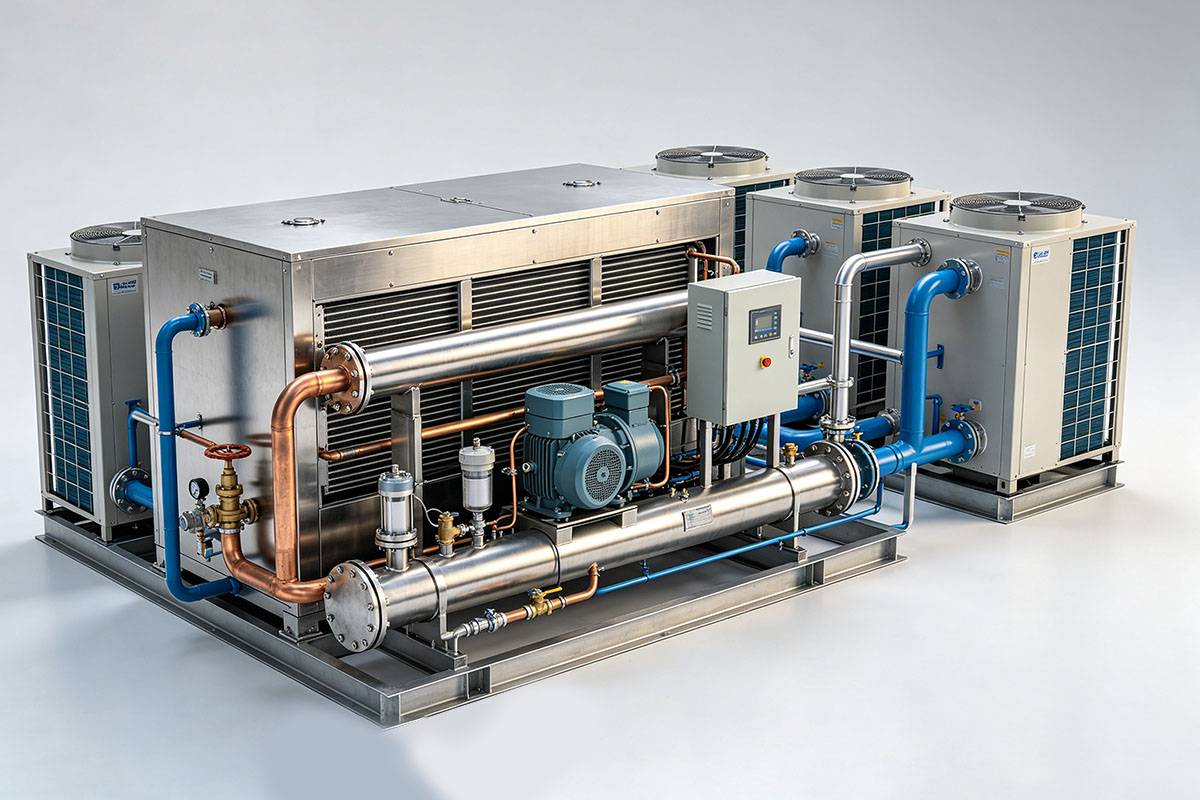
The system consists of central water-cooled outdoor units and independent indoor air handling terminals, connected by refrigerant pipelines, with cooling water directly linked to the vessel’s seawater main pipeline.
Water-cooled outdoor unit: Equipped with shell-and-tube seawater condenser made of BFe10-1-1 copper-nickel alloy tubes with outstanding seawater erosion resistance. Compressors and refrigeration circuits are integrated inside, centrally placed in ventilated engine rooms and connected to vessel seawater supply & return lines to dissipate waste heat through continuous seawater circulation.
Indoor air handling terminals: Multiple styles including vertical cabinet, ceiling concealed and wall-mounted are optional for independent temperature & humidity control of single cabins. Terminal housings are fabricated from 316L stainless steel with passivation anti-corrosion treatment, built with multi-stage salt mist filters, silencing air ducts and heat exchange coils.
All units pass seawater side pressure resistance test, refrigerant tightness test and continuous running commissioning before delivery. Only seawater pipeline connection, refrigerant piping and power access are required for onboard operation.
Five Core Differentiated Advantages
● Seawater Heat Exchange Eliminates Cooling Capacity Degradation in High-Temperature Zones
Different from air-cooled models relying on sea wind for heat dissipation, this unit utilizes unlimited seawater resources for stable cooling. Even under equatorial high temperature in summer or closed high-heat engine room environment, cooling capacity barely drops, maintaining steady energy efficiency ratio and saving power during long ocean voyages.
● Split Zoned Layout Enables Independent Temperature Regulation for Separate Cabins
One central water-cooled outdoor unit can match multiple indoor terminals of various capacities. Crew cabins, wheelhouses and control rooms can be switched and adjusted separately without full-unit startup/shutdown. Outdoor units are concentrated in lower engine rooms instead of occupying valuable living deck space, optimizing cabin layout for both new ship construction and compartmentalized refitting projects.
● Full Anti-Corrosion Water Circuit for Long-Term Seawater Circulation
Seawater condenser tubes adopt marine-grade copper-nickel alloy to resist chloride ion corrosion and marine organism adhesion. Both indoor and outdoor casings are 316L stainless steel, with flanges, valves and fasteners coated with dual anti-corrosion layers. Standard seawater strainers reduce pipeline blockage caused by sediment and marine life, cutting onboard maintenance frequency.
● Noise Source Isolation Creates Quiet Living Cabins
High-noise components such as compressors and water pumps are centralized in lower outdoor units. Indoor terminals only adopt low-speed silent fans, with operating noise well below classification society limits. Multi-layer sound-absorbing cotton inside ducts eliminates vibration and noise disturbance during rest and night watch, greatly improving living comfort for ocean-going crews.
● Full Maritime Compliance & Customization Support for Vessel Projects
Designed, manufactured and inspected in accordance with CCS Rules and SOLAS conventions, electrical systems meet marine EMC standards. Custom options include vessel-specific voltages, various seawater flow rates, electric heating, dehumidification and fresh air modules. Anti-tilt shock-absorbing bases are available for special vessels to ensure stable operation under ±30° hull trim and heel.
Typical Application Scenarios
Ocean-going container ships, bulk carriers, chemical tankers, offshore research vessels, offshore wind service mother ships, fixed offshore drilling platforms. Suitable for multi-deck vessels with demands of zoned temperature control, covering crew accommodation, wheelhouses, central control rooms, dining lounges, instrument compartments and viewing areas.
Full Lifecycle One-Stop Services from Winnex Air
Winnex Air provides full technical support: zoned vessel heat load calculation, water-cooled unit capacity matching, special seawater pipeline layout design, multi-terminal compartment planning, factory anti-corrosion inspection, onboard pipeline installation guidance, system linkage commissioning, remote operation monitoring and global after-sales maintenance for marine vessels.
Conclusion
Stable high-efficiency cooling and independent compartment temperature control are core demands for medium and large ocean-going vessels. Featuring seawater circulation high-efficiency heat exchange, split zoned regulation, full seawater corrosion resistance and isolated low-noise layout,
Winnex Air Water-Cooled Split Marine Air Conditioner solves major industry drawbacks of air-cooled units and integral water-cooled equipment. It acts as a high-reliability, energy-saving HVAC choice for large ocean vessels and offshore platforms.


