

news
Related content
- Sep 09, 2026Winnex Air Direct Expansion (DX) Air Handling UnitThe Winnex Air Direct Expansion (DX) Air Handling Unit is a highly versatile and adaptive integrated temperature and air handling solution. Unlike dedicated computer room air conditioners, it is no longer limited to data center scenarios and serves a wide range of industrial, commercial, scientific and special environmental cooling needs.
- Sep 05, 2026Winnex Air In-Row Precision Air Conditioner | Optimized Cooling for High-Density Data CentersEquipped with a full Chinese high-definition large-screen graphical interactive interface and multi-level password protection to prevent illegal operation and ensure equipment safety. The system visually displays the operating status and cumulative running time of all core components in real time, allowing operators to grasp unit conditions at a glance. The built-in expert intelligent fault diagnosis system automatically identifies and accurately displays fault information, greatly reducing maintenance difficulty.
- Jul 05, 2026Full Introduction to Chilled Water In-Row Air Conditioner | Central Water Close-Coupled Cooling Equipment for Large High-Density Data CentersExplore chilled water in-row air conditioners for large data centers, delivering high-density cooling, low noise and energy-efficient operation.
- Jun 29, 2026Six Core Advantages of DX Air-Cooled In-Row Air Conditioner | Analysis of Waterless Direct Expansion Cooling Equipment for Server RoomsExplore 6 advantages of DX in-row air conditioners for server rooms: waterless cooling, modular expansion, energy savings and smart PLC control.
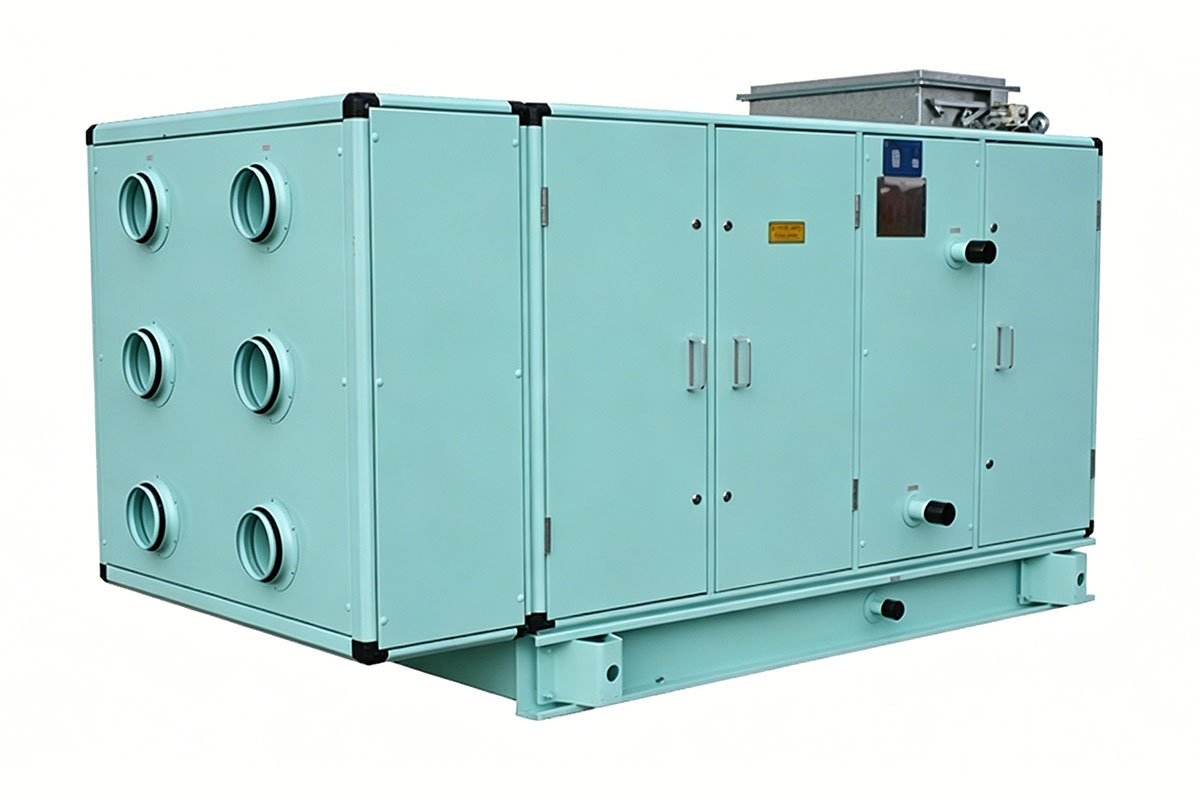
1. Rugged & Compliant Design
Harsh Environment Resilience: Equipment is purpose-built to withstand constant motion, high humidity, and salt-laden air.
Regulatory Compliance: Systems are engineered to meet rigorous international marine and offshore codes (e.g., SOLAS, ABS, USCG, and DNV).
Hazardous Area Readiness: Available explosion-proof (ATEX/Ex-Proof) and H2S filtering options for high-risk offshore zones.
2. Tailored Solutions & Innovation
Space-Saving Customization: Manufacturers offer "flat-pack" HVAC products that can be brought into ventilation compartments in pieces and assembled on-site, saving massive hull-cutting costs at shipyards.
Energy Efficiency & Automation: Intelligent automation systems and energy recovery systems (AERS) maximize efficiency, significantly lowering fuel consumption and greenhouse gas emissions.
Specialized Air Handling: Includes shockproof and electromagnetically compatible (EMC) designs for demanding environments like naval vessels.
3. Comprehensive Global Support
Turnkey Project Management: Providers often handle the entire process—from initial heat load calculations and system design to manufacturing, installation, and commissioning.
Lifelong Maintenance: Global service networks and remote monitoring options (like Aeron Connect) allow for troubleshooting even while ships or rigs are in rough waters


