

Related content
- Sep 09, 2026Winnex Air Direct Expansion (DX) Air Handling UnitThe Winnex Air Direct Expansion (DX) Air Handling Unit is a highly versatile and adaptive integrated temperature and air handling solution. Unlike dedicated computer room air conditioners, it is no longer limited to data center scenarios and serves a wide range of industrial, commercial, scientific and special environmental cooling needs.
- Sep 05, 2026Winnex Air In-Row Precision Air Conditioner | Optimized Cooling for High-Density Data CentersEquipped with a full Chinese high-definition large-screen graphical interactive interface and multi-level password protection to prevent illegal operation and ensure equipment safety. The system visually displays the operating status and cumulative running time of all core components in real time, allowing operators to grasp unit conditions at a glance. The built-in expert intelligent fault diagnosis system automatically identifies and accurately displays fault information, greatly reducing maintenance difficulty.
- Jul 05, 2026Full Introduction to Chilled Water In-Row Air Conditioner | Central Water Close-Coupled Cooling Equipment for Large High-Density Data CentersExplore chilled water in-row air conditioners for large data centers, delivering high-density cooling, low noise and energy-efficient operation.
- Jun 29, 2026Six Core Advantages of DX Air-Cooled In-Row Air Conditioner | Analysis of Waterless Direct Expansion Cooling Equipment for Server RoomsExplore 6 advantages of DX in-row air conditioners for server rooms: waterless cooling, modular expansion, energy savings and smart PLC control.
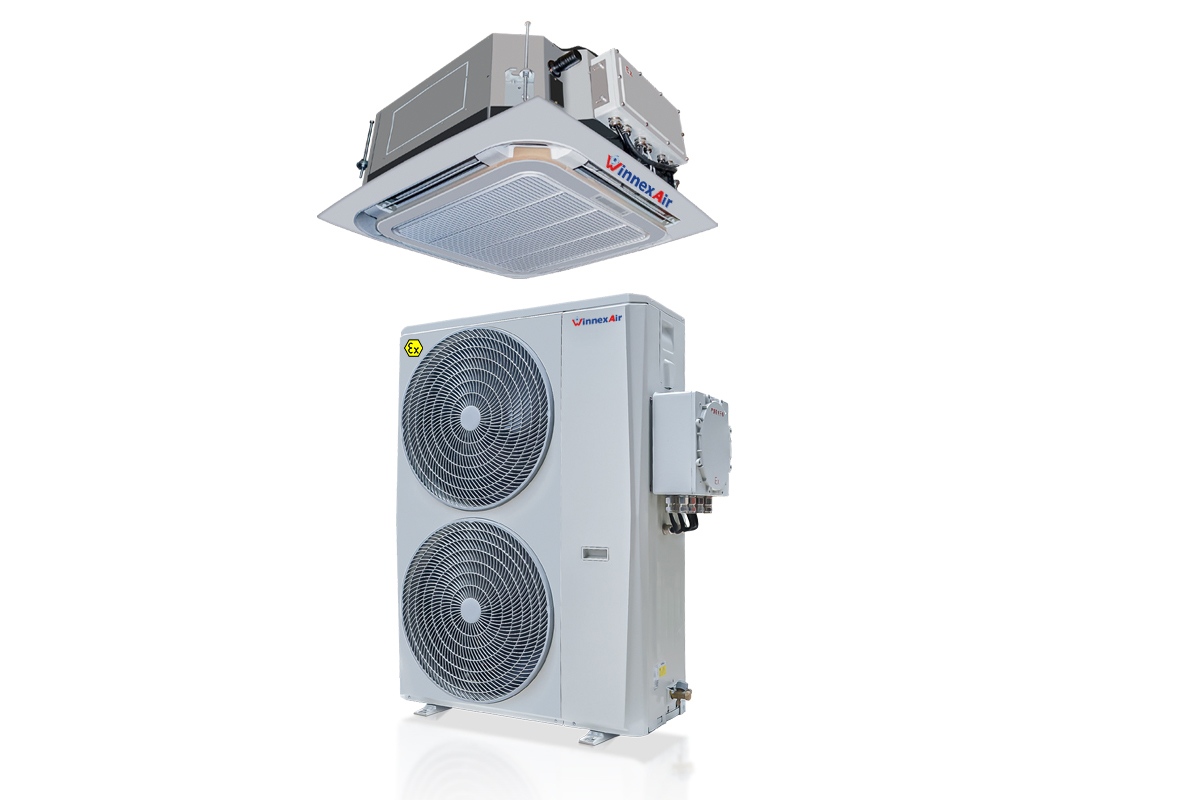
The stable operation of an explosion-proof air conditioner relies on efficient heat dissipation capabilities—especially in high-risk environments such as petroleum and chemical industries, where heat dissipation directly affects temperature control accuracy and equipment lifespan. Combining the special design of explosion-proof air conditioners and industry application experience, Winnex Air has sorted out 7 core points for you, helping to continuously protect the equipment's heat dissipation efficiency and ensure both safety and temperature control meet standards.
1. Choose the Right Installation Location: Reserve "Sufficient Space" for Heat Dissipation
Prioritize well-ventilated and open areas during installation, avoiding narrow enclosed spaces or obstacles (such as equipment cabinets, pipelines). Ensure at least 30cm of unobstructed space around the air conditioner. This not only allows cold air to circulate freely but also prevents hot air accumulation, reducing heat dissipation load from the source—especially suitable for equipment-dense scenarios such as chemical workshops and oil tank areas.
2. Regularly Clean Heat Dissipation Components: Clear "Heat Dissipation Obstacles"
The condenser, evaporator, and heat sink of the air conditioner are the core of heat dissipation, which are prone to accumulating dust and oil stains (especially in coal mines and metal processing workshops) during long-term operation. It is recommended to gently sweep the surface dust with a soft brush every month, blow off deep-seated dust with compressed air (pressure ≤ 0.4MPa) every quarter, or clean the gap debris with a vacuum cleaner to prevent dirt from blocking the heat dissipation channel and ensure rapid heat conduction.
3. Ensure Air Circulation: Make Heat Dissipation "Smoother"
It is strictly forbidden to stack goods, tools, and other items at the air inlet and outlet of the air conditioner to ensure unobstructed air flow; if installed in a relatively airtight control room or analysis cabin, explosion-proof axial fans can be used to enhance air convection and accelerate the discharge of hot air—Winnex Air can provide a combined solution of "explosion-proof air conditioner + explosion-proof fan" to further improve heat dissipation efficiency.
4. Check Refrigerant: Control the "Core Medium for Heat Dissipation"
Refrigerant is the key to heat transfer, and insufficient or excessive refrigerant will lead to heat dissipation failure. It is recommended to use a pressure gauge to check the refrigerant pressure (refer to the standard value in the equipment manual) every month. If abnormal pressure is found:
When refrigerant is insufficient, supplement the same type of explosion-proof refrigerant (such as R410A);
If there is a leak (the bubbling at the interface can be detected with soapy water), the leak point must be repaired first, and then recharged to avoid heat dissipation impact due to medium shortage.
5. Maintain the Air Duct System: Avoid "Heat Retention"
If the explosion-proof air conditioner is equipped with air duct for air supply (such as large chemical plants), the air duct must be checked every quarter:
Clean the dust and debris in the air duct to prevent blockage and reduce air volume;
Check whether the air duct interfaces and flanges are leaking, and repair the gaps with explosion-proof sealant to ensure that cold air is delivered accurately and reduce heat loss in the air duct.
6. Control Ambient Temperature: Reduce "Additional Heat Dissipation Pressure"
Try to avoid installing the air conditioner in high-temperature areas (such as near reactors and boilers) or high-humidity environments (such as printing and dyeing workshops). If the ambient temperature exceeds 40℃ for a long time, it will greatly increase the heat dissipation load of the air conditioner and even cause compressor overload; at this time, you can prioritize Winnex Air's high-temperature-resistant explosion-proof air conditioner, which is suitable for extreme environments above 50℃ to ensure stable heat dissipation.
7. Professional Regular Maintenance: Comprehensively "Check Heat Dissipation Hidden Dangers"
Strictly in accordance with Winnex Air's Explosion-Proof Air Conditioner Maintenance Manual, professional personnel conduct comprehensive maintenance every six months:
Check the speed of the heat dissipation fan motor and the wear of bearings to ensure efficient operation of the fan;
Test the sensitivity of the linkage between the heat dissipation system and the thermostat to avoid heat dissipation imbalance due to inaccurate temperature control;
Timely replace original accessories for aging heat dissipation components (such as heat sink gaskets) to ensure no attenuation of heat dissipation performance.


