

Related content
- Sep 09, 2026Winnex Air Direct Expansion (DX) Air Handling UnitThe Winnex Air Direct Expansion (DX) Air Handling Unit is a highly versatile and adaptive integrated temperature and air handling solution. Unlike dedicated computer room air conditioners, it is no longer limited to data center scenarios and serves a wide range of industrial, commercial, scientific and special environmental cooling needs.
- Sep 05, 2026Winnex Air In-Row Precision Air Conditioner | Optimized Cooling for High-Density Data CentersEquipped with a full Chinese high-definition large-screen graphical interactive interface and multi-level password protection to prevent illegal operation and ensure equipment safety. The system visually displays the operating status and cumulative running time of all core components in real time, allowing operators to grasp unit conditions at a glance. The built-in expert intelligent fault diagnosis system automatically identifies and accurately displays fault information, greatly reducing maintenance difficulty.
- Jul 05, 2026Full Introduction to Chilled Water In-Row Air Conditioner | Central Water Close-Coupled Cooling Equipment for Large High-Density Data CentersExplore chilled water in-row air conditioners for large data centers, delivering high-density cooling, low noise and energy-efficient operation.
- Jun 29, 2026Six Core Advantages of DX Air-Cooled In-Row Air Conditioner | Analysis of Waterless Direct Expansion Cooling Equipment for Server RoomsExplore 6 advantages of DX in-row air conditioners for server rooms: waterless cooling, modular expansion, energy savings and smart PLC control.
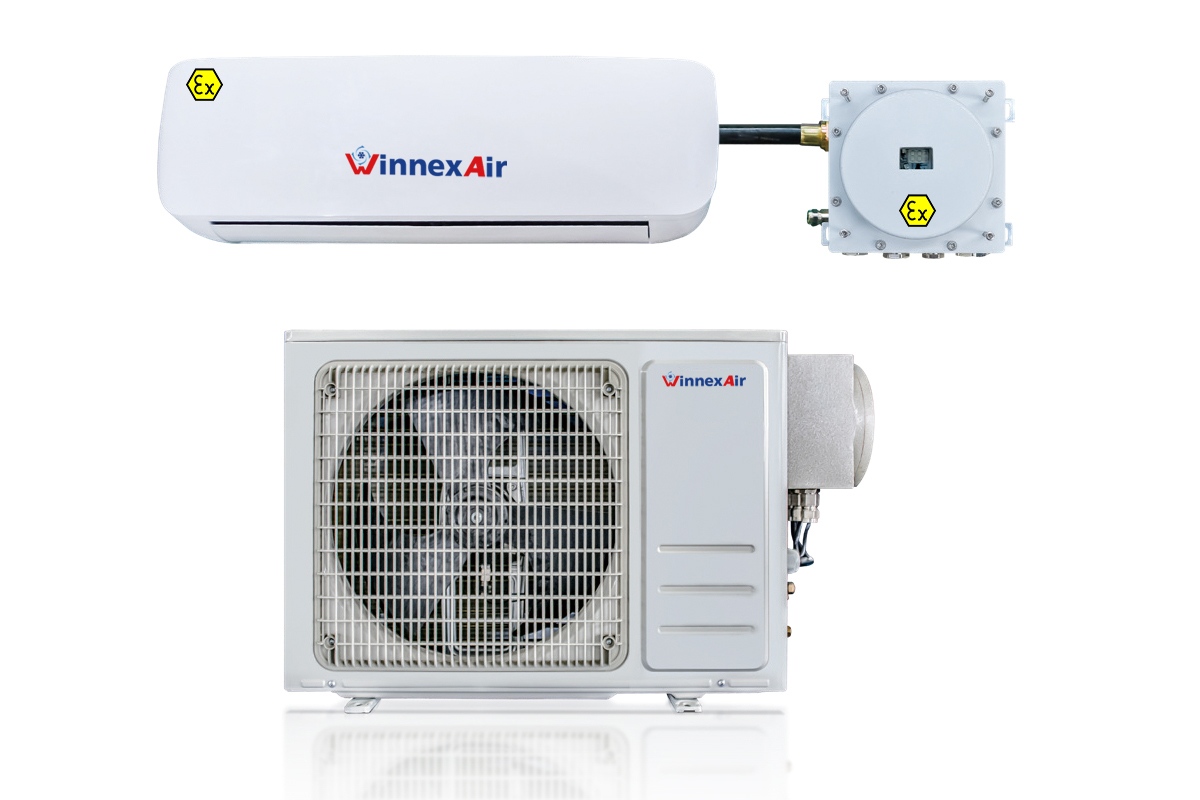
I. Core Foundation: Composition and Meaning of Explosion-Proof Ratings
The explosion-proof rating is a core identifier for judging the scenario adaptability of equipment, prefixed with "Ex", followed by "explosion-proof type + environment category + temperature class", which intuitively reflects the equipment's safe adaptation capability:
Typical Rating Examples:
> Ex d IIB T4: Flameproof (d) design, suitable for factory Class II Group B (IIB) flammable gas environments, with maximum surface temperature meeting T4 group requirements (135~200℃). Commonly used in low-risk gas scenarios such as methane and propane (e.g., general chemical workshops);
> Ex d IIC T6: Flameproof (d) design, suitable for factory Class II Group C (IIC) flammable gas environments, with maximum surface temperature meeting T6 group requirements (85~150℃). Applicable to high-risk gas scenarios such as hydrogen and acetylene (e.g., fine chemical reaction areas).
II. Key Dimension 1: Explosion-Proof Type — The "Safety Protection Structure" of Equipment
Different explosion-proof types correspond to different risk prevention logics, among which flameproof type (d) is the mainstream choice for explosion-proof air conditioners:
Flameproof type (d): The equipment shell is made of high-strength materials (such as cast aluminum alloy), which can withstand the pressure generated by the explosion of the explosive mixture inside, while preventing flame or high-temperature gas from leaking out. This ensures that the external hazardous environment is not ignited, balancing safety and durability, and is suitable for most high-risk industrial scenarios.
III. Key Dimension 2: Explosion Hazard Area and Gas Category — The "Risk Level" of Scenarios
According to the type and concentration of explosive substances in the environment, explosion hazard areas and gas categories are divided into different levels, which determine the adaptation range of the equipment:
IV. Key Dimension 3: Temperature Class — The "High-Temperature Prevention Upper Limit" of Equipment
The temperature class corresponds to the maximum surface temperature of the equipment under normal and fault conditions, which must be lower than the ignition temperature of the explosive substances in the environment to avoid risks caused by high temperatures:
V. Authoritative Standards: Global Universal and China-Specific Safety Norms
The production and selection of explosion-proof air conditioners must comply with international and national authoritative standards to ensure compliance and safety:
1. International Standards:
> IEC 60079 Series (International Electrotechnical Commission): A globally universal standard for explosion-proof electrical equipment, covering safety requirements for different scenarios, such as IEC 60079-0 (basic requirements) and IEC 60079-1 (flameproof type requirements). It is the core compliance basis for exported products;
> NEMA 250/251/252 (National Electrical Manufacturers Association, USA): Targeting the North American market, it specifies the safety performance requirements of equipment in Zones 0, 1, and 2 (explosive gas environments), suitable for projects in the United States and North America.
2. Chinese Standards:
GB 3836 Series (China National Standard): A mandatory norm that domestic explosion-proof equipment must follow, such as GB 3836.1 (general requirements) and GB 3836.2 (flameproof type requirements). It covers different environments such as flammable gases and dust, and is a mandatory standard for domestic project selection.
VI. Winnex Air's Advantages in Rating Adaptation
Winnex Air's full range of explosion-proof air conditioners strictly complies with standards such as GB 3836 and IEC 60079, covering all ratings from Ex d IIB T4 to Ex d IIC T6. Customized solutions can be provided according to the "gas type + temperature environment + risk level" of the customer's scenario, ensuring that each piece of equipment accurately meets the needs. This not only avoids safety hazards caused by "insufficient rating" but also eliminates cost waste caused by "excessive rating".


