

Related content
- Sep 09, 2026Winnex Air Direct Expansion (DX) Air Handling UnitThe Winnex Air Direct Expansion (DX) Air Handling Unit is a highly versatile and adaptive integrated temperature and air handling solution. Unlike dedicated computer room air conditioners, it is no longer limited to data center scenarios and serves a wide range of industrial, commercial, scientific and special environmental cooling needs.
- Sep 05, 2026Winnex Air In-Row Precision Air Conditioner | Optimized Cooling for High-Density Data CentersEquipped with a full Chinese high-definition large-screen graphical interactive interface and multi-level password protection to prevent illegal operation and ensure equipment safety. The system visually displays the operating status and cumulative running time of all core components in real time, allowing operators to grasp unit conditions at a glance. The built-in expert intelligent fault diagnosis system automatically identifies and accurately displays fault information, greatly reducing maintenance difficulty.
- Jul 05, 2026Full Introduction to Chilled Water In-Row Air Conditioner | Central Water Close-Coupled Cooling Equipment for Large High-Density Data CentersExplore chilled water in-row air conditioners for large data centers, delivering high-density cooling, low noise and energy-efficient operation.
- Jun 29, 2026Six Core Advantages of DX Air-Cooled In-Row Air Conditioner | Analysis of Waterless Direct Expansion Cooling Equipment for Server RoomsExplore 6 advantages of DX in-row air conditioners for server rooms: waterless cooling, modular expansion, energy savings and smart PLC control.
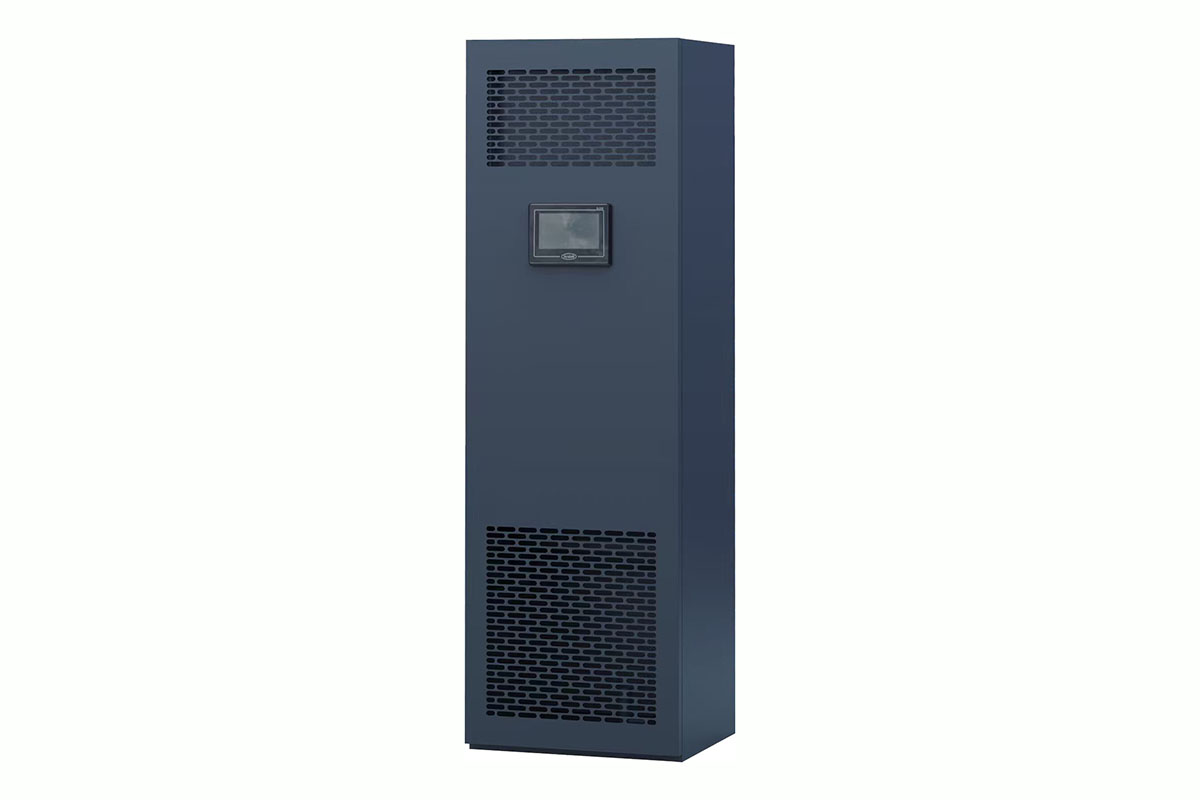
Based on deployment modes and cooling principles, data center air conditioners are divided into room-level precision air conditioners, in-row precision air conditioners and in-rack cooling units. According to heat rejection methods, they include DX air-cooled type, chilled water type and free-cooling refrigerant pump type, fully covering application scenarios from small legacy server rooms to large cloud data centers and AI computing centers.
Ordinary air conditioners are designed for human comfort and cannot adapt to harsh server room conditions. They suffer from frequent start-stop cycles, poor precision, excessive dehumidification and incapability of eliminating rack local overheating.
Data center precision air conditioners are professionally designed for equipment heat dissipation. They support year-round non-stop operation with temperature precision of ±0.5℃ and humidity precision of ±5%RH. The high sensible heat ratio design avoids unnecessary dehumidification, preventing condensation, static electricity and equipment moisture failure. Equipped with intelligent load adjustment, self-diagnosis and redundant backup functions, they fully meet the long-term high-load operation requirements of IT equipment.
As a traditional mainstream cooling solution, room-level units are placed at room corners, adopting raised floor air supply or top air supply to cool the whole server room. Suitable for low-density racks, traditional government and enterprise rooms, and telecom rooms. With mature technology, simple deployment and easy maintenance, it is a classic choice for small and medium-sized conventional computer rooms.
The new-generation dedicated solution for high-density server rooms. Installed closely between IT racks, it adopts close-coupled cooling with ultra-short airflow paths to fundamentally eliminate air mixing and rack hotspots. Air-cooled in-row units require no water system, ideal for modular pods, edge rooms and renovation projects; chilled water in-row units feature higher energy efficiency and lower PUE, perfectly suitable for large-scale high-density cloud data centers and AI computing centers.
Upgraded based on DX air-cooled or chilled water units with refrigerant pump free cooling system. In low-temperature seasons, the compressor can be shut down, and the refrigerant pump drives passive circulation heat exchange to realize zero-compression free cooling, greatly reducing annual energy consumption and lowering data center PUE.
1. Guarantee Stable Operation of Computing Equipment
Precise temperature and humidity control avoids server downtime caused by overheating, condensation, static electricity and humidity abnormality, ensuring 24/7 uninterrupted service delivery of data centers.
2. Support High-Density Computing Upgrade
Fully adaptable to both traditional low-density racks and high-density AI computing racks. Close-coupled precise cooling solves heat dissipation bottlenecks of high-load rooms and supports computing capacity expansion.
3. Intelligent Energy Saving & Low OPEX
Full frequency conversion and free cooling technology realize on-demand cooling output, avoid energy waste, effectively reduce data center PUE and cut long-term electricity and maintenance costs.
4. Intelligent O&M for Modern Data Centers
Compatible with DCIM system docking, remote monitoring, group linkage and automatic fault alarm, adapting to the development trend of modular, intelligent and unattended data centers.
Cloud data centers, AI computing centers, supercomputing centers, government and enterprise core server rooms, financial data rooms, 5G edge rooms, telecom base station rooms, containerized modular data centers, and energy-saving renovation projects of legacy server rooms.


