

news
Related content
- Sep 09, 2026Winnex Air Direct Expansion (DX) Air Handling UnitThe Winnex Air Direct Expansion (DX) Air Handling Unit is a highly versatile and adaptive integrated temperature and air handling solution. Unlike dedicated computer room air conditioners, it is no longer limited to data center scenarios and serves a wide range of industrial, commercial, scientific and special environmental cooling needs.
- Sep 05, 2026Winnex Air In-Row Precision Air Conditioner | Optimized Cooling for High-Density Data CentersEquipped with a full Chinese high-definition large-screen graphical interactive interface and multi-level password protection to prevent illegal operation and ensure equipment safety. The system visually displays the operating status and cumulative running time of all core components in real time, allowing operators to grasp unit conditions at a glance. The built-in expert intelligent fault diagnosis system automatically identifies and accurately displays fault information, greatly reducing maintenance difficulty.
- Jul 05, 2026Full Introduction to Chilled Water In-Row Air Conditioner | Central Water Close-Coupled Cooling Equipment for Large High-Density Data CentersExplore chilled water in-row air conditioners for large data centers, delivering high-density cooling, low noise and energy-efficient operation.
- Jun 29, 2026Six Core Advantages of DX Air-Cooled In-Row Air Conditioner | Analysis of Waterless Direct Expansion Cooling Equipment for Server RoomsExplore 6 advantages of DX in-row air conditioners for server rooms: waterless cooling, modular expansion, energy savings and smart PLC control.
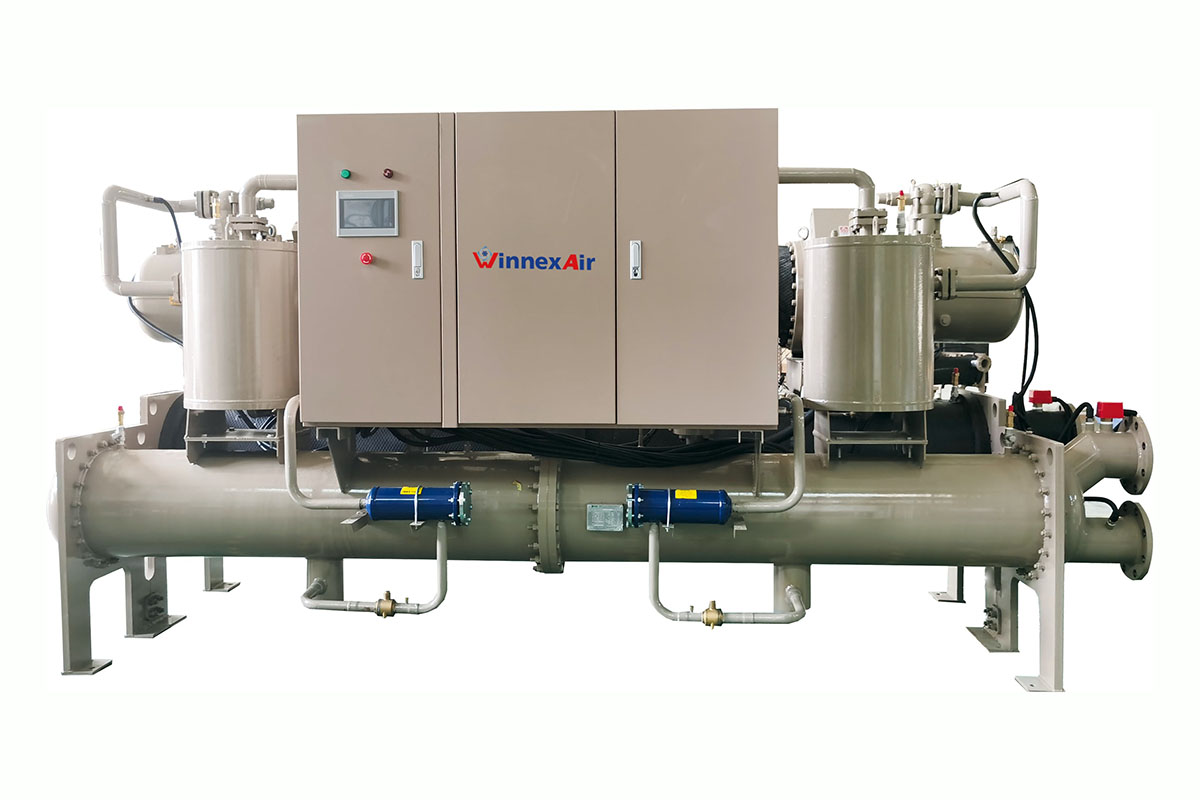
In the realm of central cooling for modern large-scale facilities and industrial processes, the water-cooled screw chiller stands out for its exceptional efficiency and proven reliability. At Winnex Air, we integrate cutting-edge technology with precision engineering to deliver optimal solutions. This blog delves into the fundamental working principle of the water-cooled screw chiller, unveiling the science behind its performance.
The Core Cycle: Vapor-Compression Refrigeration
The operation of a water-cooled screw chiller is based on the fundamental vapor-compression refrigeration cycle. This cycle efficiently transfers heat by continuously circulating a refrigerant through four key components (Evaporator, Compressor, Condenser, Expansion Device), causing it to undergo phase changes in a closed loop.
Step-by-Step Working Process
●Evaporation (Heat Absorption)
System return water (e.g., from air handling units or process equipment) flows through the tubes of the evaporator. Inside the evaporator shell, low-pressure, low-temperature liquid refrigerant absorbs heat from the water, causing it to boil and evaporate into a low-pressure vapor. This process continuously cools the water, producing the required chilled water supply.
●Compression (Energy Addition)
The refrigerant vapor is then drawn into the screw compressor – the heart of the unit. The compressor utilizes two precisely machined, intermeshing rotors (screws) to compress the gas in a continuous, smooth motion. This action significantly increases the pressure and temperature of the refrigerant, transforming it into a high-pressure, high-temperature superheated vapor. The screw mechanism offers inherent advantages: smooth operation, low vibration, high efficiency, and capacity control via a slide valve that enables seamless modulation from 10% to 100% to match the exact system load.
●Condensation (Heat Rejection)
The hot, high-pressure vapor discharges into the condenser. Here, cooling water from an external cooling tower flows through the condenser tubes, removing heat from the refrigerant vapor surrounding them. The refrigerant rejects its latent heat at constant pressure, condensing back into a high-pressure liquid. The heat is ultimately rejected to the atmosphere via the cooling water loop.
●Expansion (Pressure Reduction)
The high-pressure liquid refrigerant passes through an expansion valve (or electronic expansion valve). This metering device creates a deliberate pressure drop, causing the refrigerant's temperature and pressure to fall sharply. A portion of the liquid flashes into vapor, resulting in a cold, low-pressure mixture of liquid and vapor ready to re-enter the evaporator and repeat the cycle.
Why Choose Screw Technology?
Compared to other compressor technologies in the medium to large capacity range, screw compressors offer unmatched benefits for chillers: their simple design with fewer moving parts ensures exceptional reliability and longevity; the continuous compression process results in very low vibration and noise; and the wide, stable capacity control allows the unit to maintain high efficiency even at part-load conditions, leading to substantial energy savings for the operator.


