

Related content
- Sep 09, 2026Winnex Air Direct Expansion (DX) Air Handling UnitThe Winnex Air Direct Expansion (DX) Air Handling Unit is a highly versatile and adaptive integrated temperature and air handling solution. Unlike dedicated computer room air conditioners, it is no longer limited to data center scenarios and serves a wide range of industrial, commercial, scientific and special environmental cooling needs.
- Sep 05, 2026Winnex Air In-Row Precision Air Conditioner | Optimized Cooling for High-Density Data CentersEquipped with a full Chinese high-definition large-screen graphical interactive interface and multi-level password protection to prevent illegal operation and ensure equipment safety. The system visually displays the operating status and cumulative running time of all core components in real time, allowing operators to grasp unit conditions at a glance. The built-in expert intelligent fault diagnosis system automatically identifies and accurately displays fault information, greatly reducing maintenance difficulty.
- Jul 05, 2026Full Introduction to Chilled Water In-Row Air Conditioner | Central Water Close-Coupled Cooling Equipment for Large High-Density Data CentersExplore chilled water in-row air conditioners for large data centers, delivering high-density cooling, low noise and energy-efficient operation.
- Jun 29, 2026Six Core Advantages of DX Air-Cooled In-Row Air Conditioner | Analysis of Waterless Direct Expansion Cooling Equipment for Server RoomsExplore 6 advantages of DX in-row air conditioners for server rooms: waterless cooling, modular expansion, energy savings and smart PLC control.
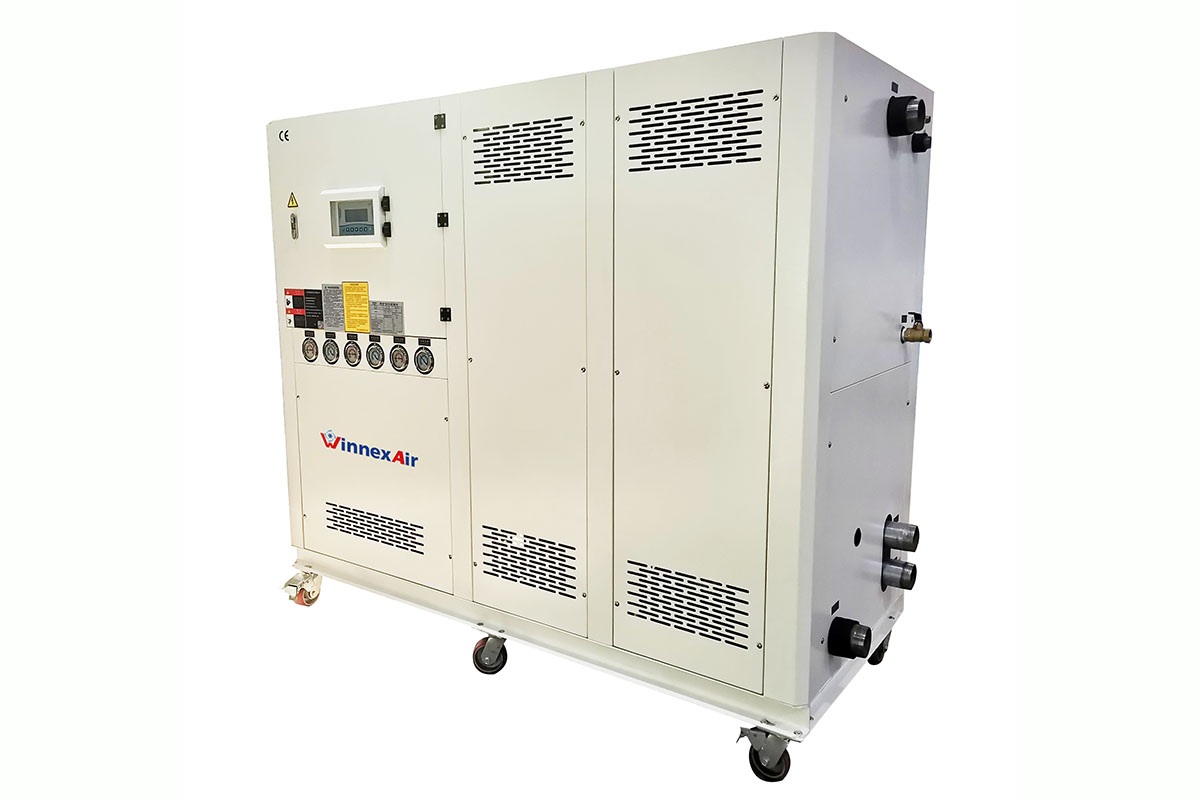
For small to medium-scale precision cooling and comfort applications, water-cooled scroll chillers are the preferred choice in commercial buildings, precision manufacturing, and modular data centers, renowned for their exceptional energy efficiency, remarkable operational smoothness, and proven reliability. At Winnex Air, we master the core essence of scroll technology, transforming ingenious mechanical principles into stable and powerful cooling performance. This article clearly explains the working principle of the water-cooled scroll chiller, revealing the robust cooling capability beneath its quiet operation.
The Core Cycle: Efficient Vapor-Compression Refrigeration
Water-cooled scroll chillers operate on the efficient and proven vapor-compression refrigeration cycle. By continuously circulating and phase-changing the refrigerant through four key components—the Evaporator, Compressor, Condenser, and Expansion Valve—the system transfers heat from the internal process to the outside environment, thereby consistently generating chilled water.
Detailed Step-by-Step Process
1.Evaporation (Heat Absorption / Chilling)
The process water or HVAC return water to be cooled flows through the tube bundle of the evaporator. Inside the evaporator shell, low-pressure, low-temperature liquid refrigerant absorbs heat from the water in the tubes, causing it to evaporate into a low-pressure, low-temperature vapor. This phase-change process continuously removes heat from the water, producing chilled water at the desired setpoint temperature.
2.Scroll Compression (The Power Core)
The refrigerant vapor is then drawn into the scroll compressor, the key to the unit's efficiency and smooth operation. Inside, an orbiting scroll revolves around a fixed stationary scroll, driven by the motor. Their precise meshing creates a series of crescent-shaped gas pockets that move from the periphery toward the center, continuously and smoothly reducing in volume. This unique mechanism compresses the gas without pulsation, transforming the refrigerant into a high-pressure, high-temperature superheated vapor. The inherent low-vibration and low-noise characteristics of scroll technology are fully demonstrated here.
3.Condensation (Heat Rejection)
The hot, high-pressure refrigerant vapor discharges into the condenser. Here, cooling water from an external cooling tower circulates through the condenser tubes, efficiently absorbing the heat carried by the refrigerant vapor. The refrigerant releases its latent heat of condensation at constant pressure, changing phase from a vapor back into a high-pressure liquid.
4.Expansion (Cycle Regeneration)
The high-pressure liquid refrigerant flows to the expansion valve. Acting as the system's metering device, the expansion valve precisely controls the refrigerant flow, causing a sharp drop in its pressure and temperature. A portion of the liquid flashes into vapor, resulting in a cold, low-pressure mixture of liquid and vapor, now ready to re-enter the evaporator and efficiently absorb heat again, thus completing the full refrigeration cycle.
Why Choose Scroll Technology?
The core advantages of the scroll compressor lie in its minimalist moving parts and inherent operational smoothness. With no direct metal-to-metal contact between the two scrolls, wear is minimal, ensuring exceptional reliability and service life. Its near-continuous compression process results in very low vibration and noise, with outstanding Energy Efficiency Ratios (COP), particularly at part-load conditions. It presents an ideal solution for users prioritizing quiet operation and stable performance.
Winnex Air water-cooled scroll chillers are deeply engineered based on this classic yet advanced working principle. Through optimization of the scroll profiles, matching with intelligent control logic, and meticulous system calibration, we ensure every unit not only embodies sophisticated theory but also delivers on the promise of "High Efficiency, Quiet Stability, and Unwavering Reliability" in practical application, providing a solid foundation for your precise temperature control needs.


