

news
Related content
- Sep 09, 2026Winnex Air Direct Expansion (DX) Air Handling UnitThe Winnex Air Direct Expansion (DX) Air Handling Unit is a highly versatile and adaptive integrated temperature and air handling solution. Unlike dedicated computer room air conditioners, it is no longer limited to data center scenarios and serves a wide range of industrial, commercial, scientific and special environmental cooling needs.
- Sep 05, 2026Winnex Air In-Row Precision Air Conditioner | Optimized Cooling for High-Density Data CentersEquipped with a full Chinese high-definition large-screen graphical interactive interface and multi-level password protection to prevent illegal operation and ensure equipment safety. The system visually displays the operating status and cumulative running time of all core components in real time, allowing operators to grasp unit conditions at a glance. The built-in expert intelligent fault diagnosis system automatically identifies and accurately displays fault information, greatly reducing maintenance difficulty.
- Jul 05, 2026Full Introduction to Chilled Water In-Row Air Conditioner | Central Water Close-Coupled Cooling Equipment for Large High-Density Data CentersExplore chilled water in-row air conditioners for large data centers, delivering high-density cooling, low noise and energy-efficient operation.
- Jun 29, 2026Six Core Advantages of DX Air-Cooled In-Row Air Conditioner | Analysis of Waterless Direct Expansion Cooling Equipment for Server RoomsExplore 6 advantages of DX in-row air conditioners for server rooms: waterless cooling, modular expansion, energy savings and smart PLC control.
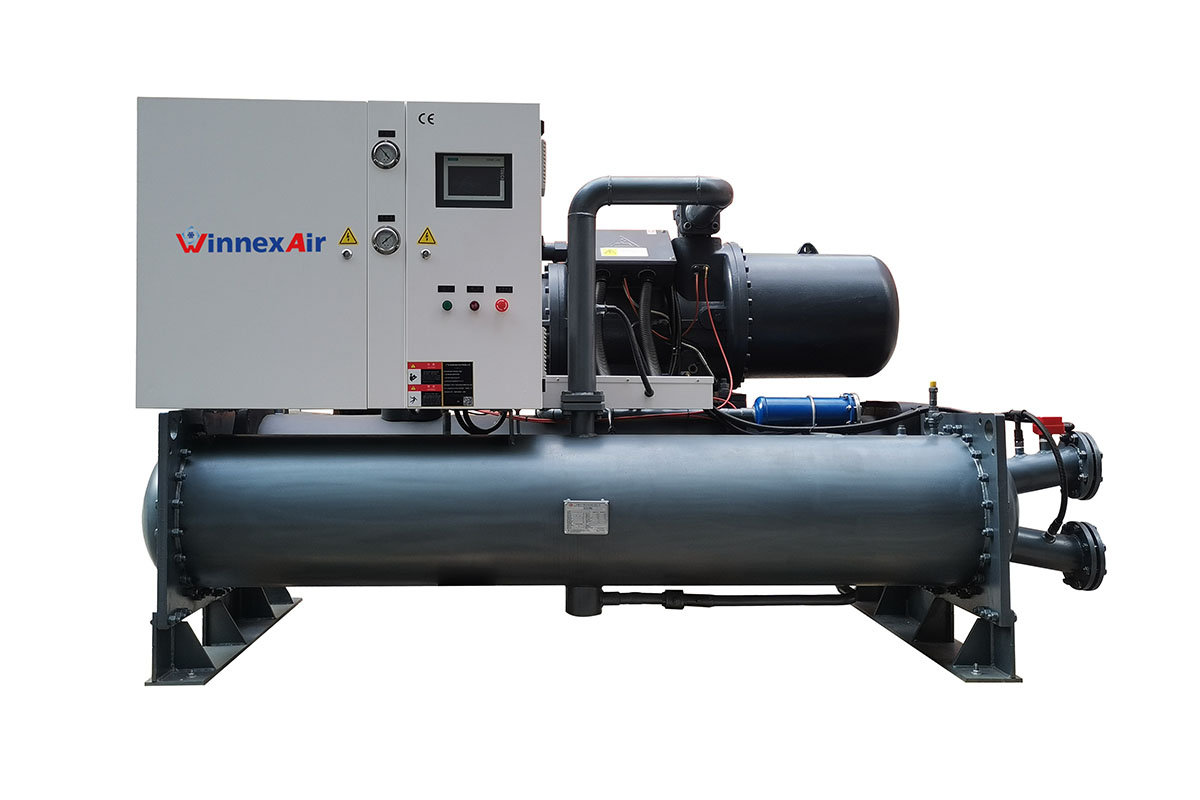
In modern industrial production, the stable operation of precision equipment and precise process temperature control are inseparable from reliable cooling solutions. As a core refrigeration equipment, the industrial chiller relies on mature vapor compression refrigeration cycle technology to provide constant temperature, constant flow, and constant pressure cooling guarantee for various industries. It fundamentally solves problems such as equipment overheating and process temperature fluctuations, helping to improve production efficiency and product quality.
The core working logic of an industrial chiller is to realize the transfer and dissipation of heat through the cyclic phase change of refrigerant between gas and liquid. The entire process requires no complex operation and runs automatically. It is mainly divided into four core steps, which are interlocking to form a closed cycle to ensure continuous and stable refrigeration.
1. Compression: The Core Power of the Cycle
As the "heart" of the industrial chiller, the compressor is responsible for sucking in the low-temperature and low-pressure refrigerant gas generated in the evaporator, and converting it into high-temperature and high-pressure gas through mechanical compression. This process not only improves the energy level of the refrigerant but also provides core power for the entire refrigeration cycle, ensuring efficient heat transfer. Different types of chillers on the market (such as screw type and scroll type) have different compressor selections, but the core compression principle remains the same. Among them, the DC inverter compressor can automatically adjust the power according to the load, achieving the dual advantages of energy saving and stability.
2. Condensation: Efficient Heat Dissipation
After the high-temperature and high-pressure refrigerant gas enters the condenser, it exchanges heat with the external cooling medium (air for air-cooled type, cooling water for water-cooled type) and releases a large amount of heat carried by itself. After heat dissipation, the high-temperature and high-pressure gaseous refrigerant is gradually cooled and condensed into high-pressure liquid refrigerant, completing the first heat transfer——discharging the heat in the refrigerant to the external environment. Air-cooled chillers do not need supporting cooling towers and are easy to install; water-cooled chillers have higher refrigeration efficiency and are suitable for large-load industrial scenarios.
3. Throttling: The Key Link of Pressure and Temperature Reduction
The high-pressure liquid refrigerant flows through the throttle expansion valve (or capillary tube), which is equivalent to the "throttle valve" of the refrigeration cycle. It can quickly reduce the pressure and temperature of the refrigerant, converting it into a low-temperature and low-pressure gas-liquid mixture. This step prepares for the subsequent evaporation and heat absorption, ensuring that the refrigerant can efficiently absorb heat in the evaporator to realize the preparation of chilled water.
4. Evaporation: The Preparation Process of Chilled Water
After the low-temperature and low-pressure gas-liquid mixed refrigerant enters the evaporator, it fully exchanges heat with the circulating water, absorbs the heat of the circulating water and evaporates quickly, and finally completely converts into low-temperature and low-pressure gas. In this process, the circulating water cools down due to heat absorption, becoming chilled water that meets industrial needs; the evaporated refrigerant gas is re-sucked into the compressor to start the next cycle. At the same time, the circulating water pump delivers the prepared chilled water to the equipment or process that needs cooling, takes away the heat generated by equipment operation or process reaction, and then sends the heated circulating water back to the evaporator for re-cooling, forming a complete water circulation system.
In addition, the temperature control system of the industrial chiller uses temperature sensors, PID algorithms and other modules to real-time monitor the water temperature and automatically adjust the operating state, ensuring that the water temperature control accuracy can reach ±0.1℃, meeting the needs of industries such as semiconductors and pharmaceuticals that have extremely high requirements for temperature accuracy. The entire working process follows the law of conservation of energy, does not generate additional heat, and only realizes heat transfer through the phase change of refrigerant, which is both environmentally friendly and efficient. It is an indispensable core auxiliary equipment in modern industrial production.


